The Art of Social Excellence by Henrik Fexeus
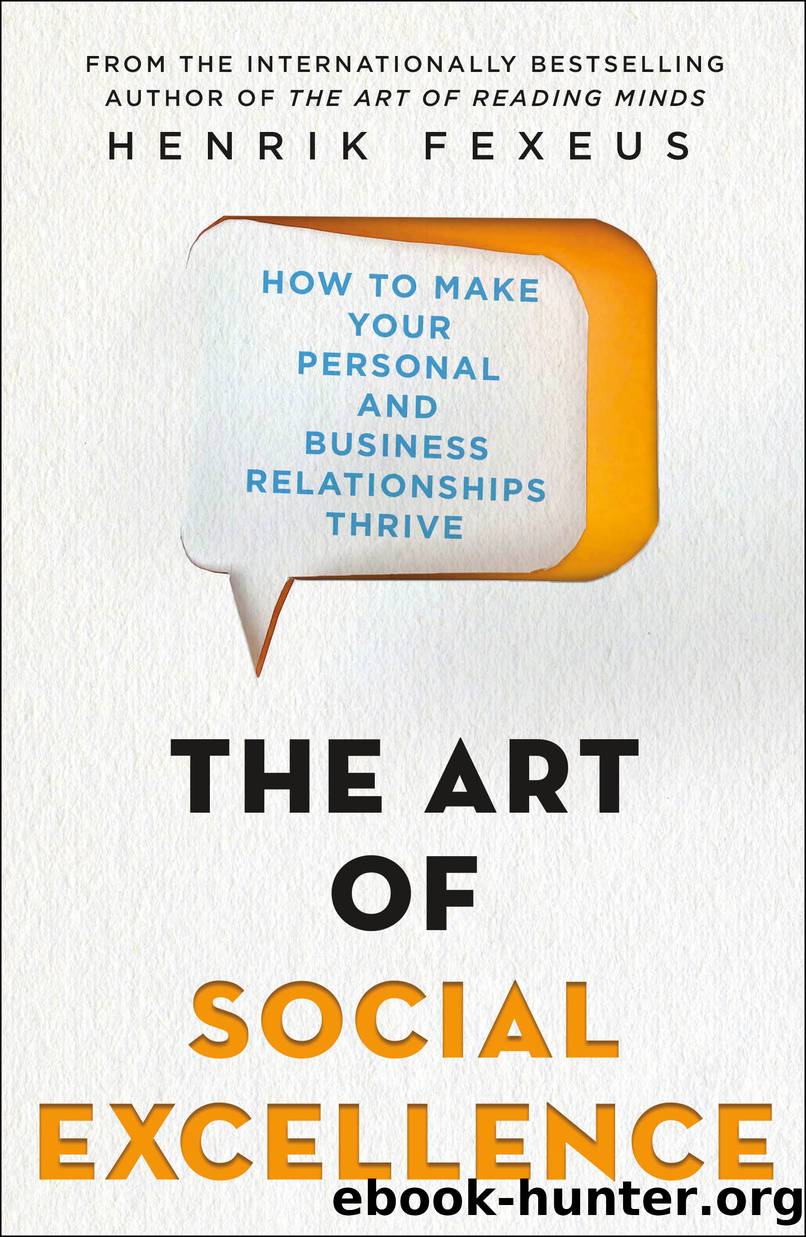
Author:Henrik Fexeus
Language: eng
Format: epub
Publisher: St. Martin’s Press
Nonverbal, Nonemotional Empathy
Nonverbal empathy is when your empathic response is based on nonverbal signals, such as facial expressions and other subconscious displays of emotions. It can help you avoid relying on stereotypes (cultural or otherwise) when your experiences are too different from those of the person youâre speaking to.
If someone is passionate about jazz music and likes to hang out in art galleries, and you yourself are more of a Mamma Mia! kind of person, there is a danger of âfilteringâ that other personâs behavior through whatever stereotype might be conjured up by those preferences. Nonverbal empathy will help you avoid doing this.
As you know, your mirror neurons will make sure to activate your own muscles for the same gesture or facial expression that youâre observing. Sometimes this mirroring is visually evident, and sometimes it isnât. But it happens either way. This is why babies that are just a few weeks old can already mimic facial expressions. Itâs an automatic process and one of the first methods we use to learn. When the expression we observe results from an emotion, our mirror neurons will also help us understand what the other person is feeling, because the muscular mirroring produces the same emotion in us, although it is weaker. Itâs even the case that if a researcher blocks out your ability to mimic expressions, by asking you to bite a pencil to force you into a smile, or by injecting Botox into your forehead to keep the muscles in the top of your face from moving, your ability to understand the feelings of others will be weakened.2
Empathic mirroring is a sensitive instrument. All it takes for the personal connection to weaken is a break in eye contact. If my hand is bleeding and I grimace while looking you in the eyes, youâll grimace, too. But if my hand is bleeding and I grimace but donât look you in the eyes, your empathy wonât be activated to the same degree. Itâs also been shown that our ability to understand the thoughts of another is drastically diminished when weâre thinking of other things, such as the personâs physical appearance. This could be one reason why people who are wearing revealing clothing often feel that others donât take them seriously. Itâs a purely neurological mechanism: when we look at scantily clad human beings (especially the kind that we are sexually interested in), areas in the brain that process objects and tools are triggered, rather than the areas that process understanding of the thoughts of others.
Basically, empathy requires presence of mind. However, this doesnât mean you should always attempt to perform an in-depth analysis of another person. Itâs often a better idea not to bother. In these situations, you can use your nonverbal understanding instead: observe the other personâs nonverbal signals, and if youâre uncertain about your interpretation, ask what the signals mean.
âWhen you speak in short sentences and donât look me in the eyes, it makes me think youâre annoyed with me. Are you?â
âWhen you slump your shoulders like that it makes you look depressed, at least in my eyes.
Download
This site does not store any files on its server. We only index and link to content provided by other sites. Please contact the content providers to delete copyright contents if any and email us, we'll remove relevant links or contents immediately.
| Anthropology | Archaeology |
| Philosophy | Politics & Government |
| Social Sciences | Sociology |
| Women's Studies |
Born to Run: by Christopher McDougall(7166)
The Leavers by Lisa Ko(6981)
iGen by Jean M. Twenge(5454)
Sapiens by Yuval Noah Harari(5409)
Spare by Prince Harry The Duke of Sussex(5259)
The Kite Runner by Khaled Hosseini(5236)
Machine Learning at Scale with H2O by Gregory Keys | David Whiting(4361)
Bullshit Jobs by David Graeber(4250)
Never by Ken Follett(4035)
Goodbye Paradise(3866)
Livewired by David Eagleman(3824)
Fairy Tale by Stephen King(3456)
Harry Potter 4 - Harry Potter and The Goblet of Fire by J.K.Rowling(3132)
A Dictionary of Sociology by Unknown(3114)
The Social Psychology of Inequality by Unknown(3089)
Will by Will Smith(2984)
The Club by A.L. Brooks(2958)
0041152001443424520 .pdf by Unknown(2890)
Harry Potter and the Deathly Hallows (7) by J.K. Rowling(2763)
